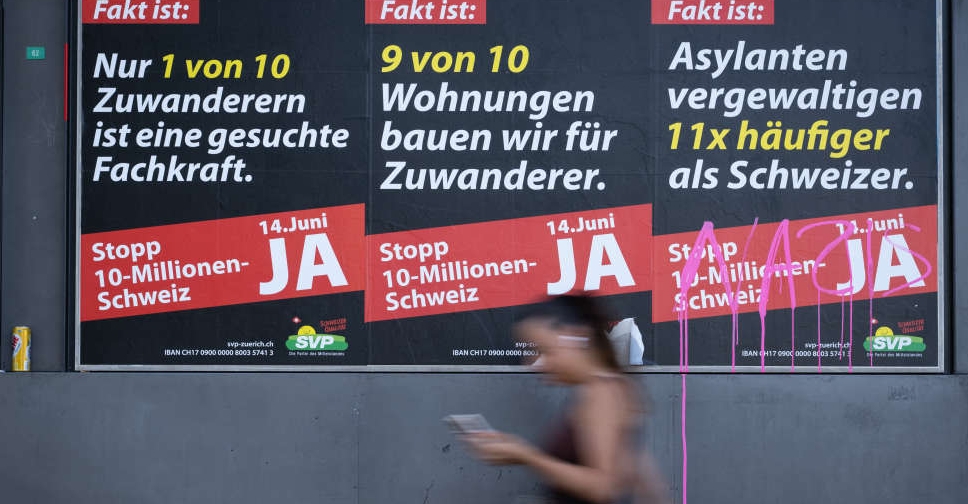
Switzerland on Sunday rejected a proposal to cap its population at 10 million as voters prioritised economic stability and ties with the European Union over worries immigration was stretching public services and pushing up rents.
A preliminary tally of a nationwide referendum showed almost 55% of Swiss voters came out against the proposal, and 45% in favour.
The vote, which was likened to Britain's 2016 Brexit referendum, had put businesses on edge due to concerns it could end the free movement of labour between Switzerland and the EU, the country's main trading partner.
Championed by the right-wing Swiss People's Party, the proposal stipulated that the population must not exceed 10 million before 2050, and that if it did so for two years, Switzerland should end freedom of movement with the EU.
The government had urged voters to reject the cap. Swiss Justice Minister Beat Jans welcomed the result but pledged to analyse what further steps could be taken to satisfy voter concerns about housing and immigration.
"With today's decision, the electorate has sent out a signal of stability, openness, and reliability," Jans told a press conference alongside Swiss President Guy Parmelin.
Urs Bieri from pollster GFS Bern said the cap failed to pass because while concern about population growth is widespread, people were worried it could damage Swiss relations with the EU and make it harder to recruit staff, and find workers like carers.
"Also there's a feeling that in the current international environment, it's not sensible for a small country to do this," Bieri said.
FOREIGNERS 28% OF SWISS POPULATION
The Swiss population already stands at 9.1 million and has grown far more quickly than in the surrounding EU. Foreigners make up nearly 28% of the total, which official projections forecast will reach 10 million by the early 2040s.
Polls had forecast a close outcome. In the end, the 'no' camp's victory was clearer than many analysts had expected.
Zurich schoolteacher Jan Hesselmann, 27, was happy with the result, but concerned by the support the proposal got. "It's the wrong way to go about it, it fuels xenophobia," he said.
The cap proposal sits alongside growing support for policies aimed at curbing immigration across Europe. Campaign posters proclaimed only 10% of incomers were needed skilled workers and that asylum seekers were more likely to be rapists.
Turnout was about 59%, well above the recent average of 48% for Swiss referendums.
Marcel Dettling, president of the Swiss People's Party, said the initiative had been very popular in rural areas, but had been ultimately been defeated by urban voters.
"Not a single problem has been solved," he said. "We will continue to push for sensible immigration."
TABOO BROKEN
Business groups welcomed the referendum result after warning that a population cap would limit access to foreign workers, damage the economy and sour relations with Brussels.
Business association economiesuisse urged Switzerland to use momentum from the result to ratify a deal it struck with Brussels in late 2024 to deepen bilateral economic ties.
EU Commission President Ursula von der Leyen said Brussels and Bern would keep working together for the good of their citizens and businesses.
Opponents had dubbed the population cap proposal a recipe for chaos because of the upheaval it could cause.
They also questioned whether it was wise to clash with Brussels after a bruising 2025, when President Donald Trump slapped the highest U.S. tariffs in Europe on Swiss goods.
The 'no' campaign ran posters with an image of a smiling Trump and the caption: "Breaking with Europe, now of all times?"
Sibel Arslan, a Green Party federal lawmaker, said the result showed Switzerland remained committed to working with its European neighbours. But she warned a taboo had been broken that was likely to resurface.
"The damage is done," she said. "This has legitimised talk about capping the population. The genie is out of the bottle."

 Avalanche kills 15 Nepali workers preparing Himalayan mountain camp
 SpaceX launches 13th long-duration astronaut crew to ISS
 Indonesia arrests captain of capsized ferry, police say
 Zimbabwean businessman, close to ruling elite, killed in helicopter crash
 Tennessee death row inmate Christa Pike survives lethal execution attempt